



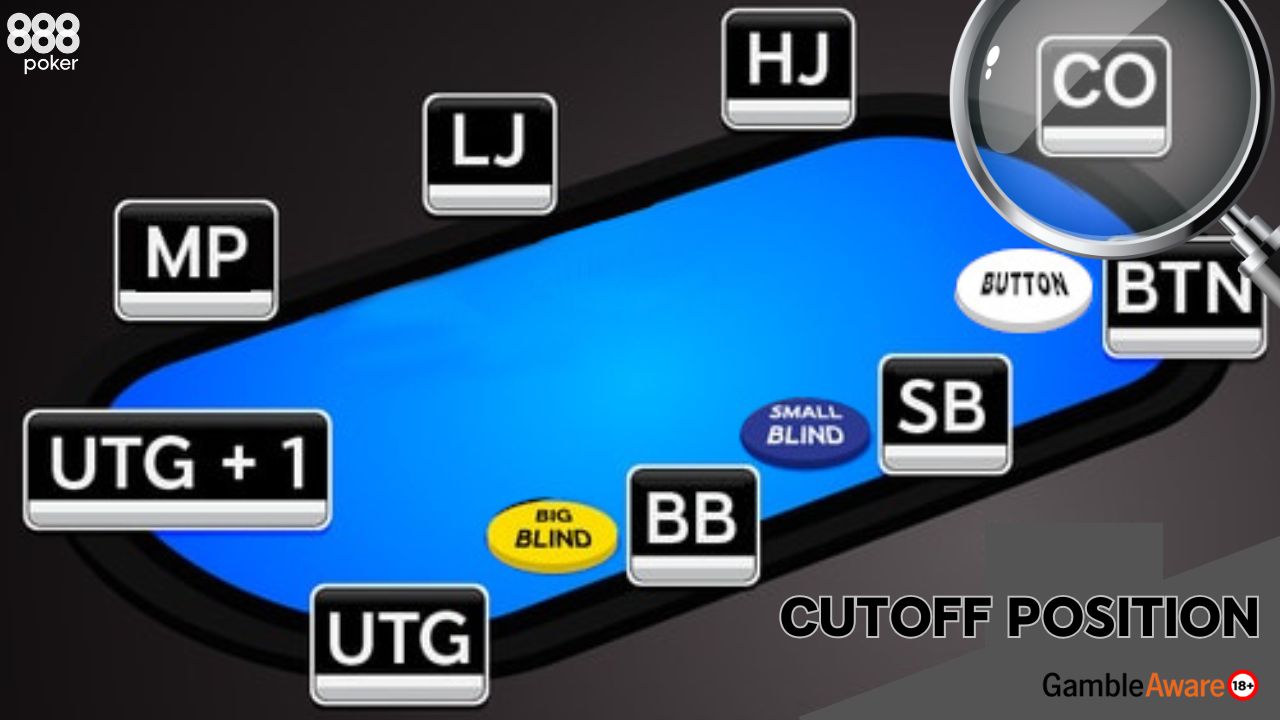
The cutoff (CO) is a seat position at the poker table – specifically, the seat immediately to the right of the button (BTN). It's the second-most profitable position in poker, behind only the button itself.
A better question than what is the cutoff is where is the cutoff, because in poker, your position determines how much information you have before acting.
Where Is the Cutoff in Poker?
Every seat at the poker table has a name. In a full six-handed (SH) or nine-handed game, the positions in order of action are:
- Under the Gun (UTG)
- Under the Gun+1 (UTG+1)
- Middle Position (MP)
- Lojack (LJ)
- Hijack (HJ)
- Cutoff (CO)
- Button (BTN)
- Small Blind (SB)
- Big Blind (BB)
The cutoff acts before the button preflop and, unless the button calls, will be in position postflop against everyone except the button. Seats rotate with each hand, so every player cycles through every position.
Is the Cutoff a Good Position?
Yes, the cutoff is the second-most profitable seat at the table. Acting after most opponents means you get to see what they do before making your own decision – a significant advantage in any poker format. The only position that acts after the cutoff postflop (barring button action) is the button itself.
Why Is It Called the Cutoff?
Two theories exist, though neither is definitive.
- The seat historically cut the cards for the dealer after the shuffle.
- The seat can "cut off" the button's positional steal by open-raising first.
The second theory is the more useful one to remember: if no one has raised by the time it reaches the button, the button will often raise with speculative holdings, knowing everyone else looks weak. The cutoff, aware of this, raises before them – cutting them off. The hijack, in turn, is aware of the cutoff's plan and may raise before them. That's the logic behind the sequence: hijack → cutoff → button.
Can You Steal from the Cutoff?
Yes, the cutoff is a standard steal position alongside the button and small blind. An open raise from the CO when action is folded to you is called a steal attempt, because there's a reasonable chance the remaining players (BTN, SB, BB) all fold, awarding you the blinds without a flop.
Stealing from the CO is slightly less profitable than stealing from the button, since the button still acts after you and can call or 3bet with position. For a full breakdown of CO open-raising ranges, defending ranges, and strategic adjustments, see the cutoff strategy guide.
How Should You Play When Facing an Open Raise?
When the CO faces an open raise from an earlier position, selectivity is key. Earlier positions have stronger opening ranges, so defending too wide is costly. For specific cold call and 3bet frequencies, ranges, and adjustments based on stack depth and opponent tendencies, the cutoff strategy guide linked above covers this in full.
What Is a Good Cutoff Win Rate?
In a standard cash game, a strong player typically targets a win rate of around 24 big blinds per 100 hands (24bb/100) from the cutoff. A significantly lower figure usually points to specific leaks: poor hand selection, too little aggression, or postflop mistakes.
Key Takeaways
- The cutoff sits immediately to the right of the button in poker – it's the second-last position to act preflop.
- It's the second-most profitable seat in poker, after the button.
- The CO is a standard steal position: open-raising when folded to you is the primary source of its value.
- When the button calls, the CO plays postflop out of position – the one significant disadvantage of the seat.
- A target win rate of ~24bb/100 is the benchmark for strong CO play in cash games.
