


The button (BTN) is the most profitable position in poker. It's guaranteed to act last on every postflop street, and it offers the best opportunity to steal the blinds preflop. Understanding how to maximise this positional edge across all common scenarios is one of the highest-value strategic skills in online poker.
This guide covers BTN strategy in NLHE cash games. Most concepts apply equally to tournaments and Pot Limit Omaha.
Why the Button Is the Best Seat in Poker
The button has two structural advantages no other position shares:
- It's guaranteed to be in position on every postflop street, regardless of what happens preflop.
- It's the last position to act before the blinds preflop, giving it the best opportunity to steal.
A steal is an open-raise from the BTN, CO, or SB – a late-position raise made with the primary goal of winning the blinds without seeing a flop. The BTN makes a successful steal when both the BB and SB fold to its open.
Even when the blinds do call, the BTN retains its positional advantage for the rest of the hand. That's what makes this seat uniquely profitable.
BTN Strategic Outlook
Two situations arise from the BTN preflop: the action is folded around to us, or a player ahead has already opened. Each calls for a different approach.
When folded around: raise aggressively. The BTN should be opening approximately 48% of holdings as a baseline and often wider against weak opponents.
When facing an open: use position. Cold-call and 3bet at frequencies that exploit the opener's range while accounting for the risk of a squeeze from the blinds behind.
Baseline frequencies:
- Raise first in (RFI): around 48%
- Cold call vs open: around 10%
- 3bet vs open: around 9%
These figures assume a range of open sizings from opponents. They're starting points, not fixed rules.
BTN Raise First In Range
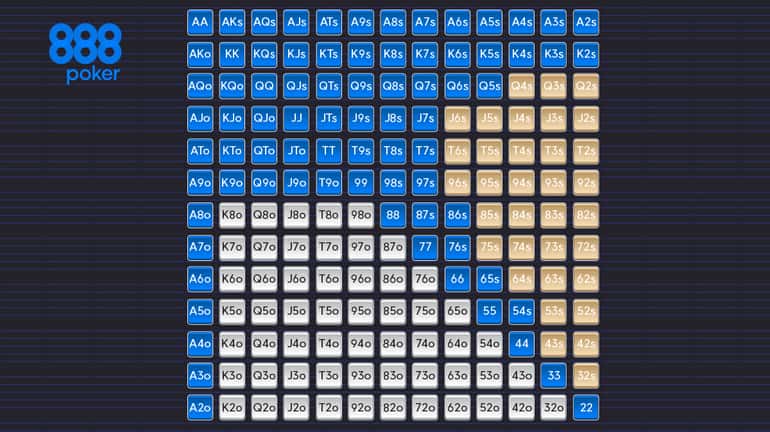
Raise first in (RFI) means open-raising preflop after it's folded around to us. This is the BTN's most profitable recurring scenario.
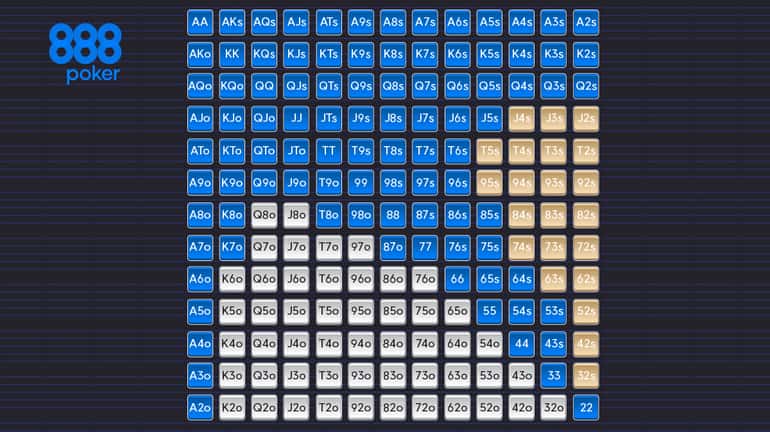
The sample range above covers approximately 48% of holdings. It's wide because the BTN is stealing into only two opponents – the SB and BB – both of whom are out of position postflop.
Competent opponents in the blinds can punish an overly wide BTN range, so there's a theoretical ceiling. In practice, though, most players in the blinds don't defend correctly. It's common for skilled BTN players to profitably open 60-70% (or even any two cards) when both blinds are playing too tight or making significant postflop mistakes.
GTO vs Exploitative BTN Opening
A BTN strategy based on GTO poker (roughly 40–43% of hands with a consistent sizing) is optimal only when both blinds are playing perfectly. That's rarely the case at any stake.
In most games, at least one of the following is true:
- The blinds are folding too much preflop.
- The blinds are making significant postflop errors.
Both are reasons to open wider than the solver recommends. The exact adjustment can't be calculated precisely because it depends on too many variables. But educated exploitation beats mechanical GTO in real game conditions.
As a practical guide, adjust BTN RFI frequency based on opponent type:
- Both blinds are very tight (nits): open 100% of hands.
- Both blinds are loose but make big postflop mistakes: open around 70%.
- One slightly weak opponent, one competent regular: open around 55%.
- Both blinds are solid: stick closer to the 48% baseline.
RFI Sizing: When to Use Smaller Opens
Most players defend reasonably against a standard 3bb BTN open, and some even slightly over-defend. Against a 2bb open, however, the average player folds far more than theory dictates.
This creates an exploitative opportunity: smaller sizings are more effective for stealing, while larger sizings extract more value from strong hands. A practical approach is to open weaker holdings for a smaller size. This isn't risk-free, though. A consistent size tell can be exploited by attentive opponents, but most players won't notice, and the occasional strong hand mixed into the small-sizing range provides enough balance.
BTN Defence vs CO Open
When the CO open-raises and the action reaches the BTN, we can defend with a cold call or 3bet. The chart below represents a sample defending range against a standard CO 3bb open.
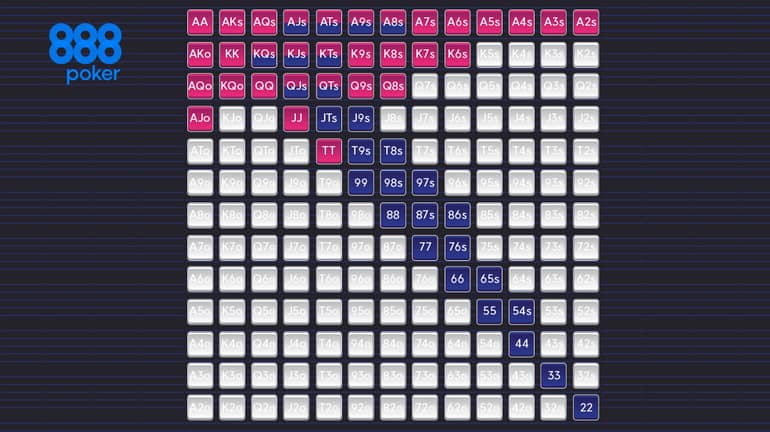
Purple: 3bet range. Blue: cold call range.
The 3bet range is weighted towards high-equity hands. Bluff-3betting speculative holdings is rarely profitable in practice. Most players don't fold as often as they theoretically should when facing a 3bet.
If the CO opens smaller than 3bb, defend wider across both the call and 3bet ranges.
BTN Defence vs Lojack Open
When defending against an earlier position, tighten up. A Lojack (LJ) open represents a stronger range than a CO open, which means fewer hands make the cut, both for calling and for 3betting.
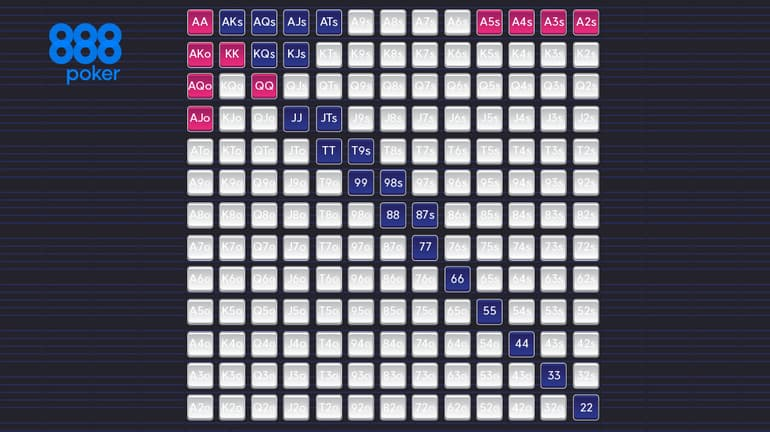
Purple: 3bet range. Blue: cold call range.
The rule: the earlier the opener's position, the tighter the BTN's defending range.
BTN vs Blinds 3bet
Stealing aggressively from the BTN will draw 3bets from the blinds. The chart below shows a sample response range: what to call and what to 4bet when facing a 3bet from the SB or BB.
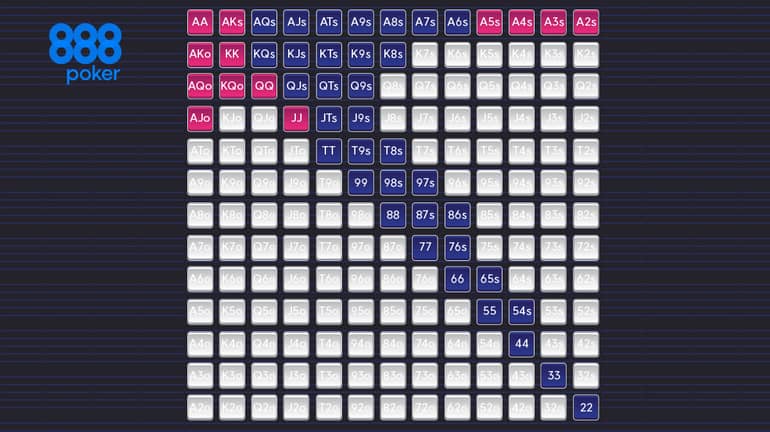
Blue: call. Purple: 4bet.
4bet bluffing is generally not incentivised. Most opponents don't fold enough when facing a 4bet, so the re-raise range stays weighted towards high-equity value hands. See our guide on 4bet strategy for a deeper breakdown.
Key Adjustments
The ranges above are baselines. In practice, several variables should push those ranges wider or tighter.
- Opponent's sizing: the larger the open, the tighter the BTN defends.
- Opener's position: the earlier the position, the stronger the range, and the tighter the BTN defends.
- Reads: if an opponent folds too much to 3bets or 4bets, increase that aggression.
- Opponent skill: weaker players justify playing more hands overall.
- Blind tendencies: if the blinds fold too much, open wider on the BTN – sometimes any two cards. If they rarely squeeze, cold-call a wider range.
Other BTN Scenarios
Iso-raising – When a player open-limps and the action reaches the BTN, the preferred response is usually a raise. An iso-raise is a preflop raise made against a limper. The BTN is the best seat in the house for this move – guaranteed position postflop means we can raise a wide range, though typically a little tighter than the standard RFI range.
Overcalling and squeezing – When facing an open and a caller, the dynamic shifts. With two opponents already in the pot, the BTN should tighten its 3bet (squeeze) range and weight its calls (overcall) towards speculative suited and connected holdings. The chart below shows a sample BTN range facing a HJ open and CO call.
- Overcall – a call made after at least one player has already called an open on the same street.
- Squeeze – a 3bet made after an open has already been called by at least one player.
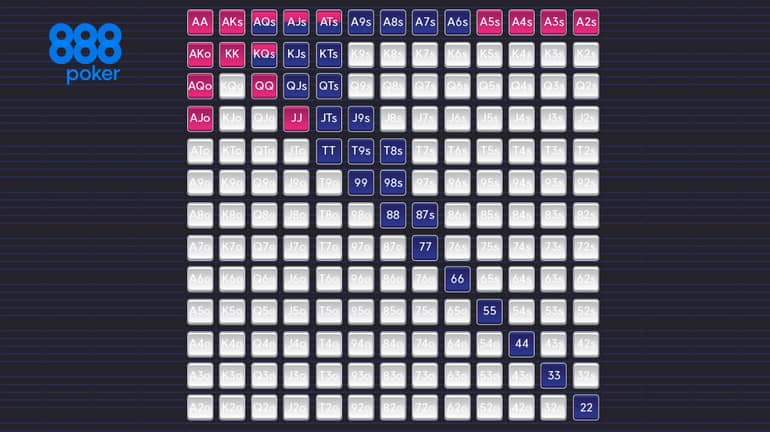
Purple: squeeze range. Blue: overcall range.
Key Takeaways
- The button is the best position in poker. It's always in position postflop and has the best angle for stealing the blinds.
- Open around 48% of hands as a baseline RFI, and expand that range significantly when the blinds are weak or folding too much.
- GTO opening frequency (40–43%) assumes perfect blind play. Since that never happens, exploitative adjustments almost always apply.
- Smaller open sizings are more effective for stealing; larger sizings extract more value from strong hands.
- Defend tighter against earlier position opens – a LJ open represents a stronger range than a CO open.
- Avoid 3bet bluffing and 4bet bluffing in most game environments – opponents don't fold as often as theory requires.
- In multi-way scenarios, tighten the squeeze range and favour speculative hands for overcalling.
