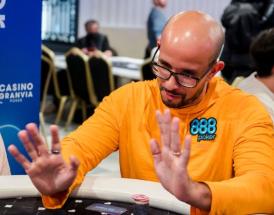
A check means that the action passes to the player on our left without us making any wager. Checking is only possible when no-one has made a bet on the current street. Say, for instance, a bet has been made before us on the current street, our options are to call, raise or fold. In this scenario, checking is not an option, because we must always at least match the bet on the current street.
To play our C-Game means that we don’t feel we are performing at our best at the tables. We feel that we are making a number of mistakes that we usually manage to avoid on a better day. The term C-game also has close ties with our mental state when playing. Playing C-game could indicate that we are getting emotionally affected by our short term results and making bad decisions as a result of frustration or ‘tilt’. Other letters may also be used to describe the quality of our game, A-game, B-game, D-Game, etc. The further up the alphabet we go, the better our game gets – with A-game being the best.
A cash game is a type of poker game where all players are free to buy-in and leave at any point. If a player loses chips he is free to buy additional chips at any point (while not in a hand). Cash games are generally the preferred game for professional players since the swings are smaller and the gains are more consistent relative to tournaments.